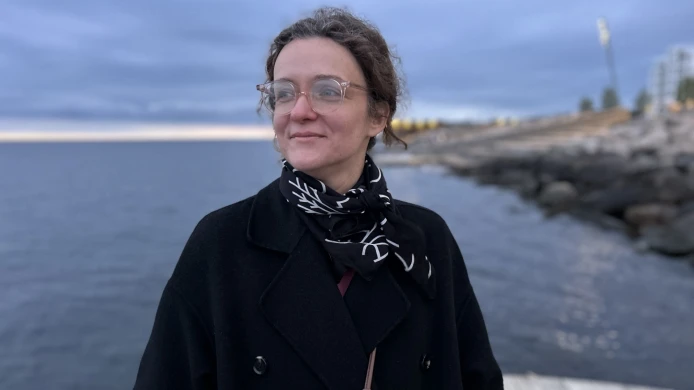
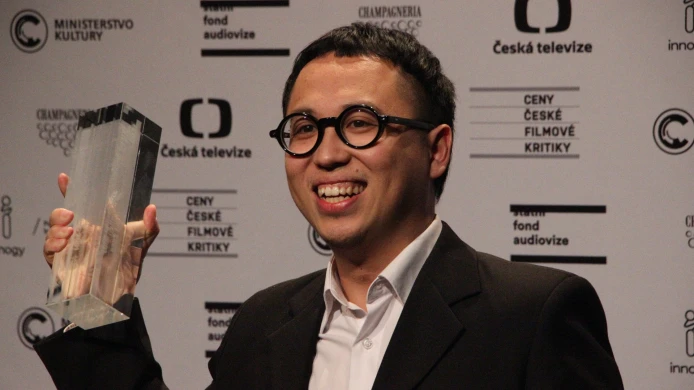
As part of this year’s Supermarket Art Fair in Stockholm, we had the opportunity to ask several questions to artists Michal Poustka, a Czech artist, and Laze Tripkov, a Macedonian artist. The interview focused on their joint presentation, their work with virtual reality, intermedia practices, and their perception of reality in a digital environment.
How would you describe your work at Supermarket Art Fair in one sentence?
LT: Immersive.
MP: I wanted to say immersive as well. (laughs)
What is the core idea of your project here?
LT: To dive into heritage experience.
MP: And mine is cognitive bias and the formation of our perception.
What role does the audience play in your work?
LT: The perception of changes in cultural identity within virtual environments.
MP: I'd love to push them to think about their own cognitive bias.
What matters more to you, image or experience?
LT: The experience is the most important because the image is still, you know. But with different media, different tools, throughout history, we have proved that we can push different limits, maybe even to an experimental stage.
MP: Yeah, definitely experience. Everything is experience.
How important is the context of the place?
LT: Well, yesterday we had a discussion about not just AI, but also about why youngsters take pictures of their food and then they start eating it so maybe I don't know it has a logic.
MP: Yeah, I think the artistic environment is somehow inspiring, but I don't think that the work is super related or really closely bound to it. But I believe to influence not just the artists, everyone.
LT: Things are changing a lot, right? We don't involve all our senses in what we try to grasp. So, slowly our physical body from mental body are separating. You know, there is a vacuum space that I think that the art only can substitute the absence. I mean, I try to push it, but I also know Michal's knowledge and approach to that, how much it means. Because this is not just artistic research, it's also theoretical research. So, it's very difficult in the community to try to find theoretical justification or to try to define something that is new or unknown. You don't have any kind of related facts or data regarding that.
MP: Maybe I'll react one more. Actually, I think the audience here or the participants are the most open persons or people to think about this, this cognitive bias. So I think it's a nice place to start.
Can art still be relevant today without interaction?
MP: It depends on what you are searching for. For me, I love interaction. I think it's one of the cornerstones of my creations. That is based on my preference, basically.
LT: I mean interaction can be just getting a brush and fixing something, you know. Everything is in that manual segment that pushes maybe more activity, a different type of activity and goal. What's the purpose of that? What's your point regarding that? What kind of awareness would you like to bring through your work or to a bigger group of people of what is the end consumer.
MP: And as my research advisor says, as soon as you perceive something, you are basically interacting with the artwork.
LT: Even understanding the plain message from a poster on the wall, you know, you already kind of interacted with it because it managed to keep your attention stucked to the visual.
How do you approach „reality“ in a digital age?
MP: Tricky. Sometimes it's hard, but I think I already got used to it. I think I'm used to reality already.
LT: I'm also getting used to the new reality. It's more social. It gets more social context than before and it's much more demanding. You have to pay attention because it's very dynamic. It changes every three to six months, especially with AI. I mean, it completely reshaped it.
MP: But you also have to let it flow somehow. Do not focus on it too much at the same time. Artists are those who need to shape the future. They should show a way, maybe point a direction. Maybe their responsibility is to kind of attract the attention just to say: "Hey, look, this is a way, this is one of the ways."
Should the audience leave with a question or an experience?
MP: I think both. I think the experience should be like the starting point for the question, or at least I hope it works like that.
LT: Yeah, you win in both cases.
What’s the biggest challenge of presenting at an art fair?
LT: I'm first time here. I'm first in any art fair. I mean, it's dynamic.
MP: You shouldn't say that.
LT: Why?
MP: You're super skilled already. (laughs)
LT: This is my... I've always been going to - (laughs)
MP: We have no struggle at all. Yeah, I think traveling, preparing, you need some tools which you don't have, you need to improvise. But again, it's a part of the experience and it raises new questions for us.
LT: You know, when we were studying, metaphor was something very important. But metaphor is also your way how you understand life, how you collect experience from life or how you learn. The harder way may be the better way. When you have everything available, then it's maybe easier, right? But you don't learn the life lesson then. Generally, the point is that an art fair is a collective of ideas, right? And that’s something that has existed for a long time. And it's interaction with people, you know, we are all part of their individual performance, but they are also part of our performance. So, this intersection, the border of actively participating with each other gives more endurance to initiatives like this.
What is currently inspiring you the most?
MP: Life, probably. Everyday absurdity. That's it, probably, for me.
LT: Survival in the digital world.
And one word that defines your work.
MP: Immersive. I want to say it first. (laughs)
LT: Intriguing. intriguing. You know, I think that media are constantly changing. The knowledge of art comes from the past. It’s about how you live with that experience in the end - whether you carry it with you, whether it will force you, or you will just treat it as a part of your daily routine. Because wherever you go and whatever you do, because we both do virtual reality, right? It's based in different kind of industries, but in the art segment it's completely different. It's something new like the computer graphics when it appeared. Those who started doing computer graphics were not accepted as artists. People were like, “Oh look, he drew something in Paint or Corel or something.” Just like photography - photography wasn't recognized as an art at first. Painters spent three months painting something, and there would be a photographer who would take a photo just to have it in one day.
MP: I hope that my work has some potential to be transformative.
What do you enjoy most about being part of Supermarket Art Fair?
LT: Friendship, hanging out, spending time together.
MP: Experience. Getting to know the surroundings, the people around, many different approaches, many different creations. It's really colourful. Yeah, I like it.