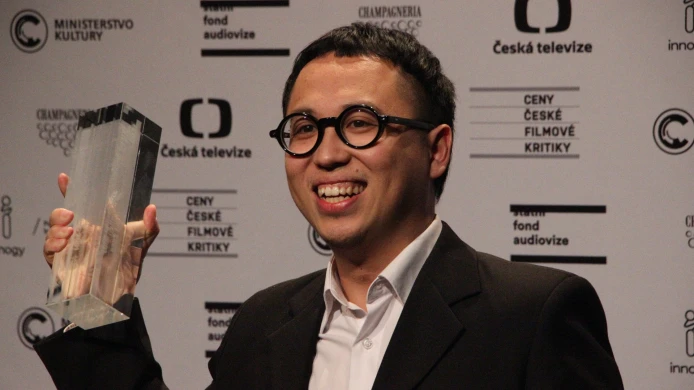
In November, Czech Centre Stockholm presented the unique film Girl America at the European Film Festival Stockholm. We were excited to welcome Jan Kadlec for a Q&A after the movie. If you missed it, we have a little treat for you in the form of an interview with Jan. "My name is Jan Kadlec, and I am the production designer of the movie Girl America (Amerikánka). I am the person who’s responsible for the overall visual concept of the movie, including the costumes."
ČC: How would you define the main theme of the set production in Girl America, not only in terms of set design, but also in costumes? Were you thinking of a specific theme while working on it?
JK: It’s a social drama, you know. It’s a real story, based on a true story. The story works as a social drama, but we can’t really explain it as only a social drama. I’m going to try another way of explaining it. I bring the concept that everything is built on the reconstruction of memories – child memories.
The process was to build it back to how it was. So that’s why different memories in the movie have different colours, and each scene looks different. Because as our memories get stuck in our brains through structure, colour, or smell, this is the crucial point where we start to create the whole space.
That’s why some scenes use Technicolour colours – of course, it’s a fiction. I always have to make some kind of anthropology of the fiction character - little bit to understand them. You always cooperate with yourself. For example, the childhood, the first memories of/on orphanage are presented in Technicolour colours, because how I remember my childhood from the Polaroid photos or from the photos which they were a little bit twisted, you know, to the way of Technicolour.

Amerikánka (Režie: Viktor Tauš, Česko, 2024), ©BioscopOn the other hand, some colours are used to support certain meanings — pink because of this kind of family, black and white because the scene is about the Velvet Revolution. That’s how we remember the revolution. When you google it, you mostly see black-and-white photos, or sometimes very saturated videos.

Amerikánka (Režie: Viktor Tauš, Česko, 2024), ©BioscopGenerally, I don’t really care about reconstructing an era through dialogue. For me, the movie is not about historical reconstruction supported by dialogue. I always try to understand emotions and to formulate emotions visually.
Especially in this movie, my goal was to bring back visuality. Film is audiovisual, and we’ve slowly started to forget that movies were originally created like paintings, like frames, like visual art. My goal was to bring that back. That’s why I also built this movie in a way that I can freeze any scene, and I can explain what it means, why the props, why the colours.
ČC: How much did you participate in the making of the movie? Because set production was a big part of the film – did you also take part in post-production or in choosing locations etc.
JK: Yes, definitely, because this is exactly the point of being a production designer. You know, it’s still an open discussion what does it mean to be a production designer. Someone calls it set designer, someone an art director. Especially in Europe it’s really a goulash and nobody understands.
I remember in 2017, during the Oscars, Jimmy Kimmel asked the audience if they knew who the production designer was. It’s difficult to understand what it is — it’s somebody, it’s a mixed salad.
Technically, the profession was created during Gone with the Wind, when the producer David O. Selznick asked the Academy if they could create a new profession, a new category. William Cameron Menzies was the first person who received an Oscar for production design, because he created a complex visual concept.
In this movie, something bad actually turned into something good. There was a situation where our costume designer — a very famous one — quit at the last minute, and it takes a long time for the production to find another costume designer. I was running and running, I don’t know weeks. I said that if they gave me four girls who were very flexible and understood textiles and costumes in general, I think I would be able to create it. And from that moment, I felt much more free, because suddenly the range was wider, you know. Before, I couldn’t really speak through the costumes. Now I was able to speak, I was able to use the costumes as another set, as a prop.
If you have the chance to be responsible for costumes as well, it gives you much more space as a production designer to formulate the visual world until the very end — until the last button — which is great.
ČC: Okay and my last question is: are you currently working on something, and can you perhaps share it with us?
JK: Yes, I can share it. I‘m working on a lot of things – on my art, a lot of, let’s say, huge sculptures. And in the movie industry, we are preparing new projects with Viktor (Tauš). Both of them will be scary movies, you know, horror kind of style. One is a movie, and one is a mini-TV series. Let’s see - I think it will be really exciting.