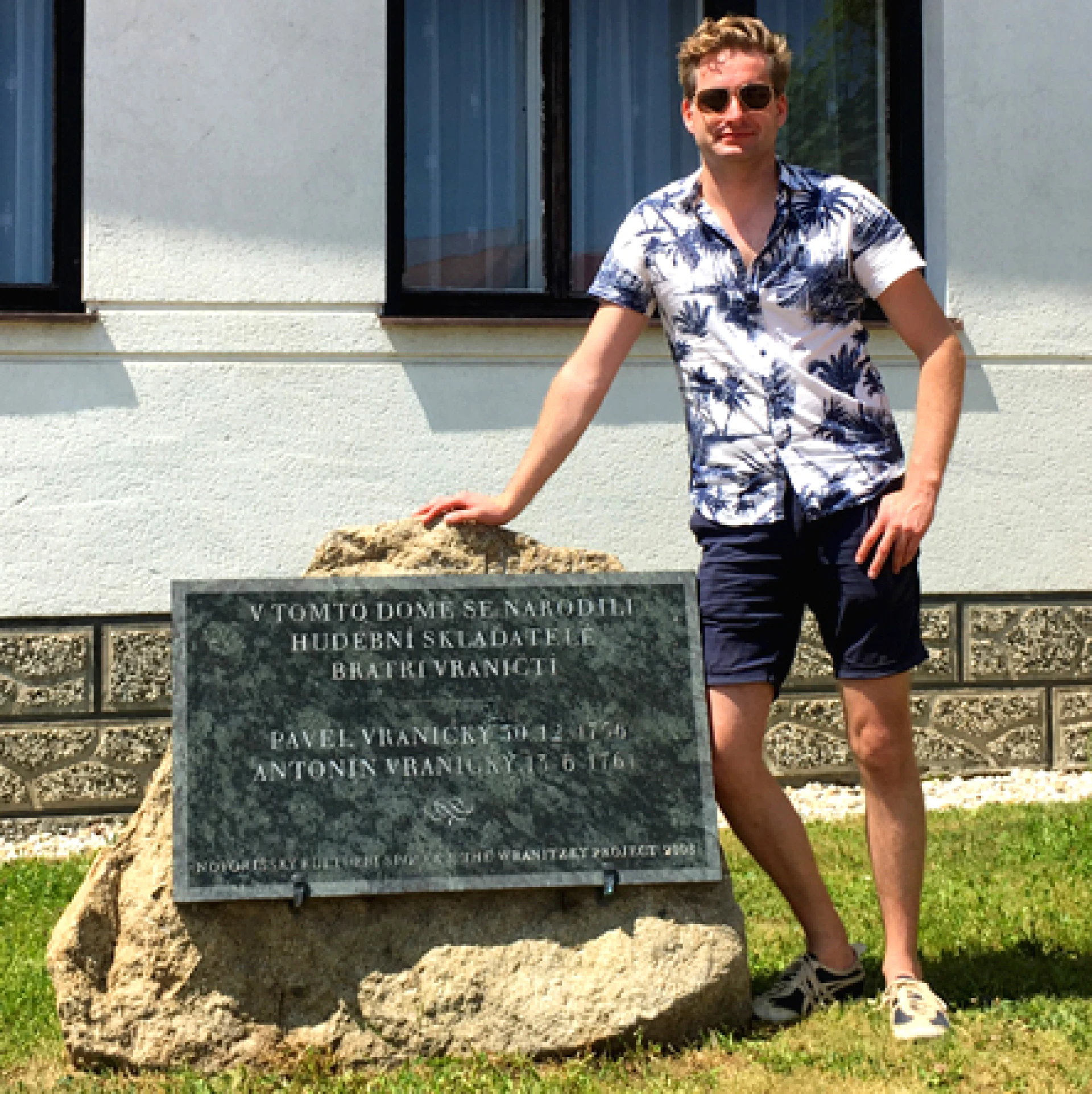
In this tough and kind of modern, full of technology, time, it is rare to find someone who is still interested in classical music. Daniel Bernhardsson is a lover of this type of music and foremost lifework of two Czech composers, who were active in Vienna at the end of 18th century.
Passion for almost forgotten classical music, especially music of Paul Wranitzky (Pavel Vranický) and Leopold Kozeluch (Leopold Koželuch) has fulfilled him for an impressive 20 years. While not working with Wranitzky or Kozeluch, he investigates the works of Eberl, Kraus, and many other 18th century composers. Daniel is a really good cellist, especially he is interested in the repertory of the late 18th century cello concerto, a genre in which Wranitzky himself produced a fine work.
It has been 15 years (*2006) since he started the project dedicated to Paul Wranitzky and his lifework. This project in the first place has been trying to arouse interest in people in Wranitzky as a great person of the past and also his work, because Daniel realized the quality of this composer’s work. On the other hand, The Wranitzky project aims to stimulate research and performances of the composer, who is being unjustly neglected. On the project website you can find every information about the composer, but also sound files are available there, so do not hesitate and visit the sites to listen to it.
Daniel was also contacted by The Akademie für Alte Musik Berlin, asking for his help with providing scores and parts for recording with symphonies by Wranitzky. Furthermore, he tells us that Naxos as a world’s leading classical music label is releasing the first volume of a new series of CD’s dedicated to Paul Wranitzky. This is part of the Czech Masters in Vienna project too. (More info) The first CD came out in April and the next one came out on July 23rd. (tune in!)
Let’s not forget Leopold Kozeluch, whom Daniel Bernhardsson also admires. Daniel has also been involved in some CD projects, as well as concerts. Truly demanding work on the final version of the overall sheet music from the extant manuscript stored at the Prague Conservatory lasted several months. We can proudly say that this result is of the activities of Daniel Bernhardsson from Sweden. There was the modern premiere of a Cantata by Kozeluch in the Czech Republic in the very beginning of June 2021, which Daniel had prepared. Unfortunately, due to the Covid-19 pandemic, it was too complicated for him to visit Czechia, therefore he did not join the performance.
SMALL INTERVIEW:
1. Before our interview, we as natives of Czechia had never heard about these composers from the Czech Republic. Why did these composers and their work impress you so much? When and where did you find him?
Daniel: I discovered both Wranitzky and Kozeluch by exploring music by composers completely unknown to me. There were many composers whose music I looked at, but Wranitzky and Kozeluch stood out because of their quality. And they were very popular and well-regarded composers in their time. I found this music in an archive in Skara here in Sweden when I had time over before taking the bus home. It would be some 17 years or so ago!
2. Is it hard to find information about Czechs and Moravian composers from the 18th century active in Vienna?
Daniel: Partly yes, because there has not been a great deal of work done in this field (compared to some other composers). Therefore, a lot of fundamental research must be done in archives.
3. Why is classical music so important to you?
Daniel: It is my big hobby and passion. It gives me stimulation, excitement, pleasure
4. Thus playing, listening to classical music, but also searching information about this music, for you it is the same when somebody is doing sport right? It is a hobby, and thanks to it, you feel much better, less stressed etc.
Daniel: I do it to unwind in the evenings, so I say yes for your question.
5. Do you agree that classical music is dying?
Daniel: No. I don't think it is dying, but it does have an aging audience. However, young people are still interested, but maybe not in the same quantities. But things like that can change.
6. Have you ever visited the Czech Republic and tried to find information there? How do you like it?
Daniel: I have been many times in CR, I don't know how many. 15 +? I like the Czech Republic very much, and I always try to combine my vacations with doing research. So, I've visited archives in Prague, of course, but also in Cesky Krumlov, Jindrichuv Hradec, Brno etc... There are many more I'd like to visit but my problem is that when I have vacation it is usual that archives might be closed.
7. Do you plan any other projects?
Daniel: I am very busy with Wranitzky and Kozeluch. I also look at different Swedish composers, but Wranitzky is absolutely my no. 1 priority. I wish I had the possibility to devote more of my time to it.
8. Do you know our romantic Czech composer Smetana or Dvorak? If yes, which work do you like most?
Daniel: Of course! I've visited the Smetana and Dvorak museums in Prague, as well as the Dvorak birthplace in Nelahozeves. The Dvorak cello concerto is a must.
9. Tell us, how do you know the Czech Centre, since when?
Daniel: I know the Czech Centre for maybe 7-8 years? I visited it when it was located at the Embassy on one of those Kulturnatten (culture night, end of April) events when it had an open house. I got some very interesting leaflets and brochures about Czech castles
10. How do you see the work of Czech Centre?
Daniel: I've gone to a few Czech centre events, and it has been very nice. It is always interesting to see different parts of other countries' cultures and heritage.
11. Have you ever participated in any event of the Czech Centre? Or have you ever performed for us, for our event?
Daniel: For Czech Centre events I have only visited. However, Ms. Zuzana invited my string quartet to play at an EUNIC meeting at Czech embassy. Where we played works by Paul Wranitzky and Leopold Kozeluch.
Thank you so much Daniel, I really appreciate taking your time to tell us about your great work and your amazing passion.