ČC: Svenstrorp Art Center was your first commission in Sweden, wasn’t it? How has it impacted your international career?
TJ: It’s actually the first built project in Sweden, yes. And right now, because of this project, I got some other commissions here as well. For example, I was commissioned to do a forest spa, which is a really exciting project. Hopefully the building permission will go through without any problems and then we are ready to build again. It’s an hour away from Svenstrorp, closer to Mariestad. I’ve never designed a forest spa before, so it will be exciting to get to create something so new.


ČC: I actually have quite a close relationship to that area, spent a lot of time there and it’s so exciting to see a culturally rich spot like the Svenstrorp in that part of Sweden. It brings so much life into the area. But it is closed during winter, right?
TJ: Yeah, we are installing the new exhibition in two weeks. But for a place like this it’s best to come during summer, when a person can sit outside and get a nice coffee as well. It has to be the whole experience.
ČC: Ah yes, fika, that’s an integral part to anything Swedish. But speaking of being inherently Swedish, you have essentially renovated an existing building, that is so distinctively Swedish, with its structure and color. How much of the old building did you want to preserve? I find it really beautiful that you were able to keep the look of a traditional countryside building, the distinct iconic red color, and simultaneously elevate it with the layering so that it stands completely apart from any other surrounding buildings.

TJ: Yeah, it’s always a careful balance. And in our case, there was also the limiting aspect of a budget while we could still play with the urban aspects and the movement of people within the space. We decided to completely change the entrances and it was really important for us that the building communicates from the outside its new purpose. That’s why we decided to really lean into playing with a new front façade, that was we treat the building more as an artwork itself. Together with Erik [Johansson], we had this idea to create a funny facade that kind of catches your eye already from a distance, so that one immediately picks up on the fact that these are no longer no longer agriculture buildings.
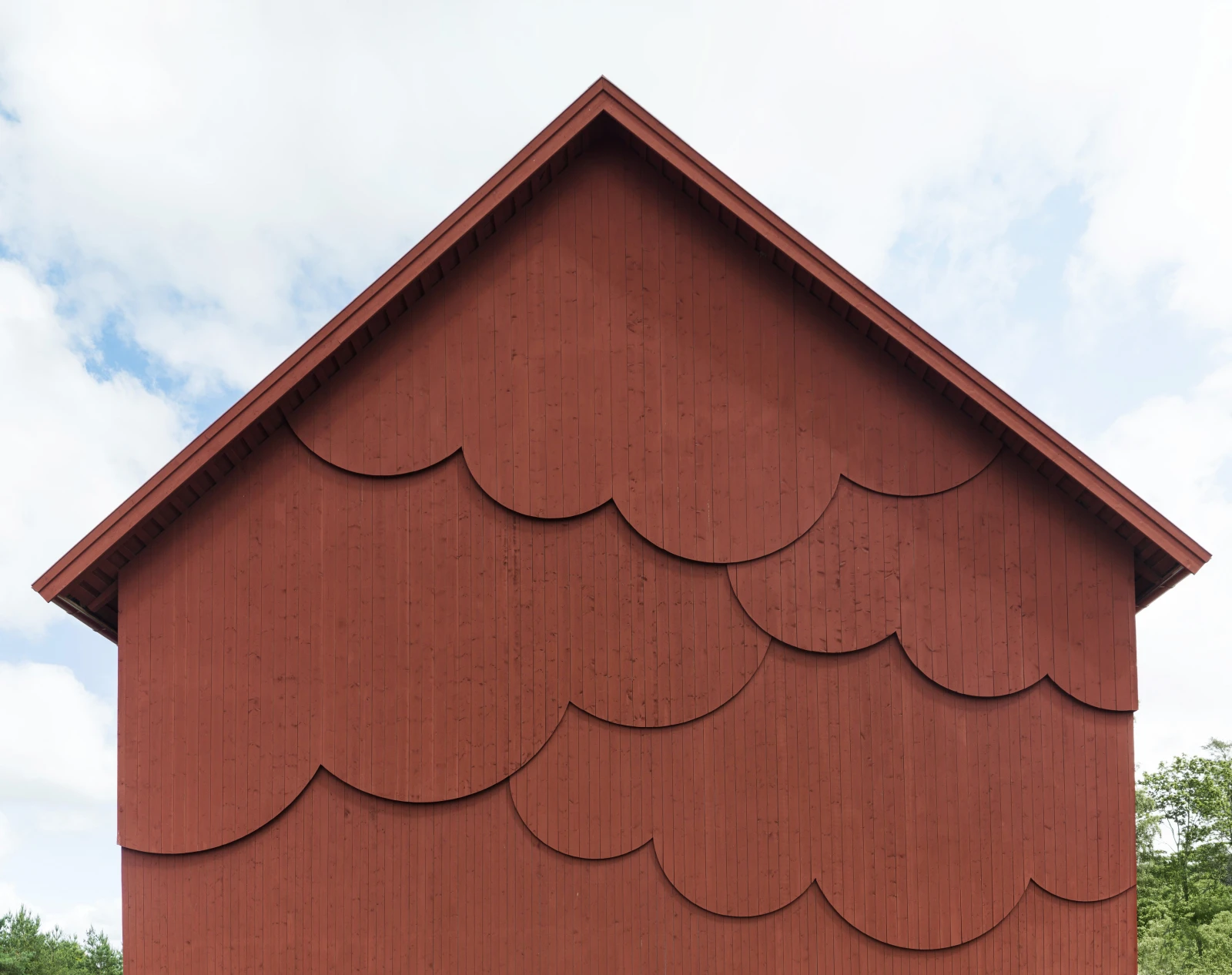
ČC: That it does it really well. It seems you figured out the balance perfectly, because while it does not disrupt its environment, it clearly sets itself apart from the rest.
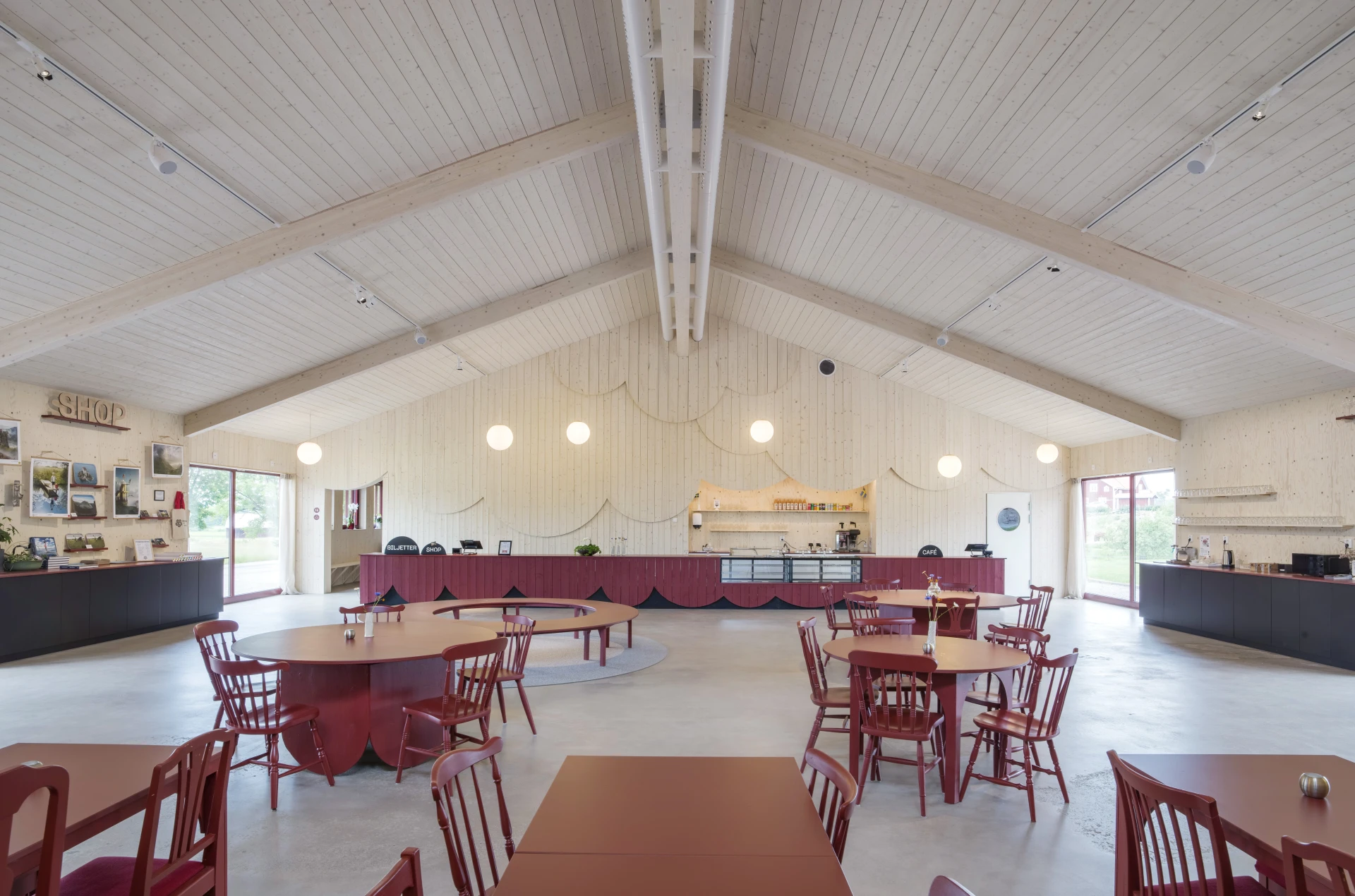
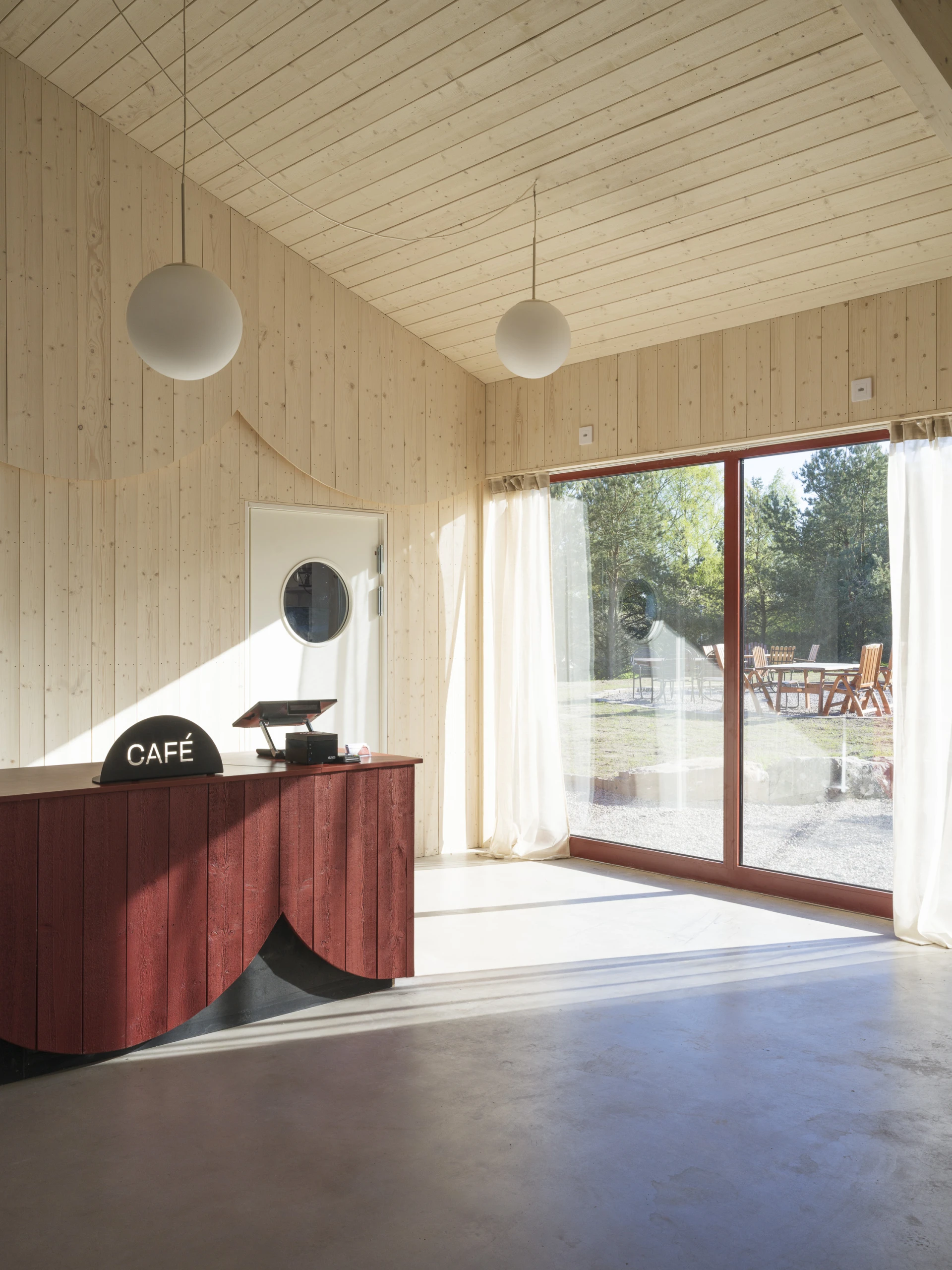
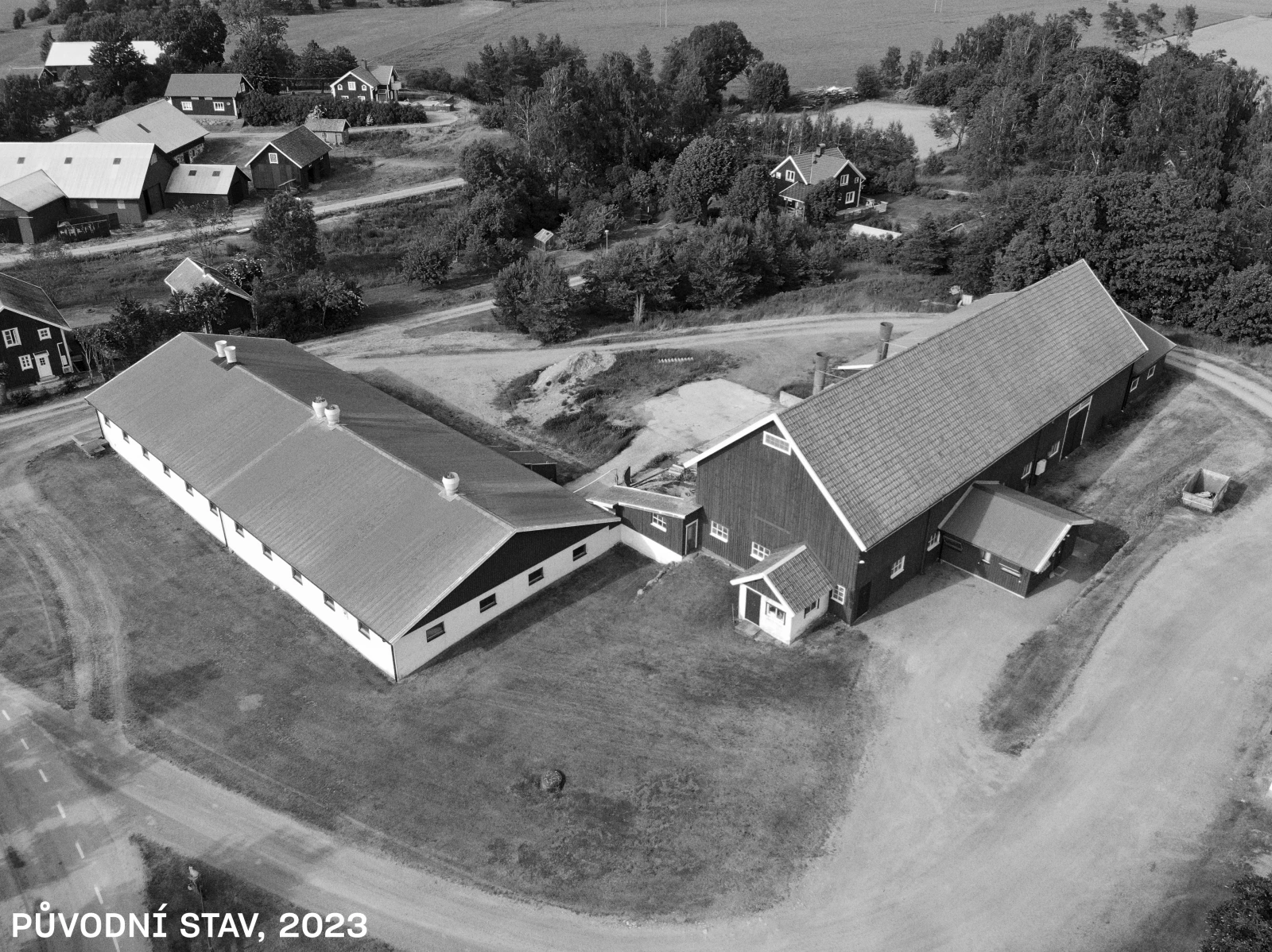
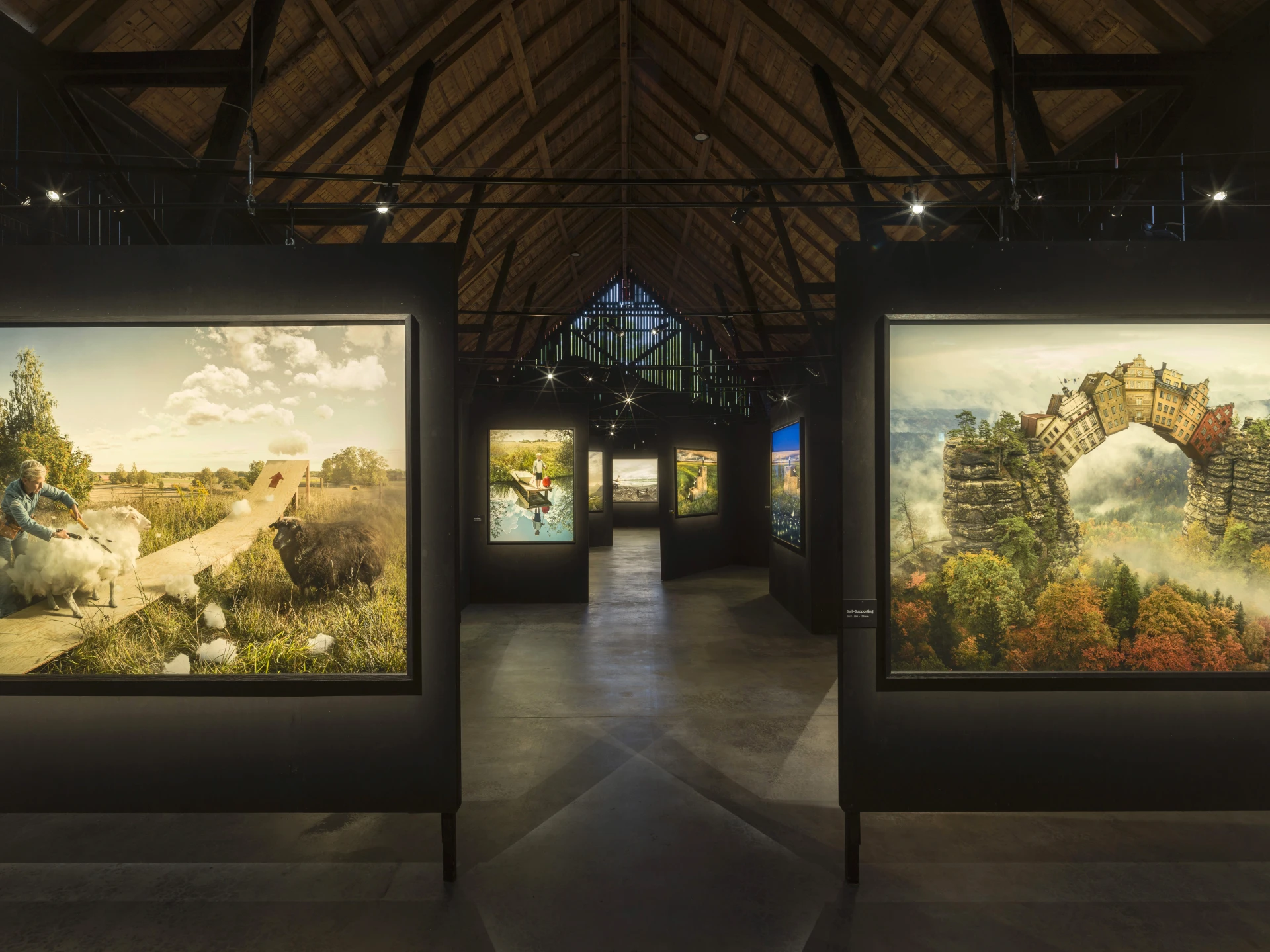
TJ: It does look really different now from what it looked like before. You will be surprised if you go to Google Maps and just search for it, because there still are the old images of the of the former buildings. Like I mentioned, we also rapidly changed the logistics of the entrances. The main element became the ramp that connects both buildings while at the same time creates a new atmosphere for the visitors. We tried to play a lot into how people move through the space. First people come into the Multifunction Hall, where they can buy coffee, tickets and sit in a really nice naturally light space. Then they go outside through this ramp into the other building which is very dark and has almost like a theatrical atmosphere – this is Exhibition Hall. Basically, we also entertained a lot the idea of a contrast of a light and a dark building. In the dark building, the art is what makes it light up. The concept is that you are not supposed to think about anything else. You can focus solely on the art, there are no distractions or disrupting factors. This is why all the light inside is regulated.
ČC: That’s actually really interesting, because the building itself is opened seasonally, right? Which is essentially for this aspect to work. A lot of buildings are seasonal in Sweden because of the big temperature differences or the darkness differences in between seasons. Was this essential to the planning of the project? Because technically the exhibitions could go on throughout the whole year as it is not dependent on sunlight, which frankly is quite rare in Sweden during winter.
TJ: There are two main reasons why we decided to do it this way. The first is that we realistically need time to prepare for each new exhibition. And we all have different jobs, like Anna-Karin, who is running the center, is also running the farm, which doesn’t really allow for any breaks. I don’t know how she actually manages as it is. [laughs] And both me and Erik, we have got different projects and Erik also has his artworks. This allows us to have some time to prepare and make each season count. And secondly, the big building where the actual art exhibitions take place is not isolated, because of budgeting at the beginning of the project. We decided to start off seasonally and then, if it becomes a success, which it appears to have been as we’ve been fortunate enough to welcome so many guests over the summer, hopefully in the future we can isolate the second building and keep it open all year round. I think it’s always important to think not only the building cost but also the maintaining cost with any project.


ČC: You have worked on this alongside your husband, Erik Johannson, who is Swedish. And this is still inherently quite a Swedish building, and it was also your first big project in Sweden. I was wondering how it was entering such project with and international background? How did that compare to your other projects? Both Czech or other?
TJ: It’s a good question. When I first visited Sweden, the first thing I noticed was the different light. It was summer, I was here for Midsommar. I came here with Erik, and it was all these beautiful long shadows and red barns and buildings everywhere. It seemed quite magical and picturesque to me. This is how I come up with the idea for the facades. I noticed that the shadows and the buildings are much stronger and so can really create something interesting, eye-catching. That is why we ended up working with the layering of wood.
Essentially, it’s something that also changes with time and may give different dimensions to the project as well. This building never looks the same, not even throughout the day. In foggy weather they are calm; when it’s sunny it appears almost as a trunk. I also like the falu red, it’s an amazing color. It’s amazing that it’s actually used everywhere, it gives the Swedish landscape a sort of fairytale-y quality.
ČC: It’s something that unites the entire countryside in Sweden which is super cozy.
TJ: We should get inspired in the Czech republic, I think. [laughs]
CČ: It’s also interesting that the material is also so united. Most buildings in the Swedish countryside are made out of wood. Could you imagine doing a project like this in the Czech Republic? Could it work on the same scale, or not really? As in would it even work to repair an agricultural building like this in the Czech Republic into an art center, into something that’s fundamentally aesthetic?
TJ: I would say that every project has a different task. You would have to consider the program very carefully. Because even for this project, the most difficult part was the actually define its task.
At first, Erik started with this idea when we worked together on a site-specific installation a long time before Svenstrorp. For example, the exhibition we did in Falun Magasinet or in The Mining Exchange. And it worked! You know, his work looks amazing in the big spaces such as these. So we figured, why not use this building if it’s available? And then we realized in order for people to visit we have to offer the whole package since the location is a bit remote. This means we have to offer some Fika probably, so that we create a place where you can spend almost the whole day. This is how the idea has started. And that could work in Czech Republic as well, of course. I don’t know if I would work with wood and I don’t know if we would have such a generous space, but it is all so individual from project to project.

CČ: Nowadays we almost notice a trend of adapting old buildings into new, but I would say in Czechia it’s mostly formally industrial buildings, where you have a lot of pipes and stuff like that. And I think there is a really nice quality, like you said, that in Sweden the buildings are very fairytale-like.
TJ: Yeah, that is true. I would say, industrial buildings are interesting because they are usually in a very good position in the cities. That’s usually because historically they used to be in the center. This is why suddenly we have an abundance of these amazing spaces in the middle of the town. But I think that now this is shifting into creating such spaces in the countryside as well.
CČ: Is there something that you've carried from your Czech background into this project? Because you studied in the Czech Republic. Is there something that has given you an advantage, next to Erik for example, who is Swedish?
TJ: Maybe this tradition of reusing materials and being very efficient with them. For example, the furniture. All of it is custom made. The construction of the tables was made in a certain way so that the cutouts are made from another structure of the building. If you look closely, we really use all of the original material. The chairs are all second-hand which we then remodeled to fit our purpose.
CČ: It’s nice you mention the furniture because the interior really does reflect the exterior in the case of Svenstrorp. The outside transfers inside as well whether it’s the shapes or the colors. It’s almost like you can turn the building inside and out. Often you have buildings that that don’t necessarily match the inside, which can also be interesting but sometimes off-putting. How did the process begin then, did you find the place yourself or were you approached by someone?
TJ: Actually, it’s a very personal project because my husband [Erik Johansson] grew up on the pig farm and it’s still in the family. His sister overtook the farm, and he is actually the first one from six generations of farmers who became an artist. Yet, he keeps coming back to this place and eventually made it his project as well. Svenstrorp is close to his family house as well. So, we knew these barns were unused and we wanted to do something with them and so it became a family project. Erik together with his sister are running the space and I am running the art program there. We also have guest exhibitions of course. The idea is that Erik has his personal exhibition there, but we change the scenography every single season. And we also have a second exhibition hall where we have guest exhibitions, which is going to be a first for this year. We already have a guest artist, which is going to be Christoffer Herwig.
ČC: Is there anything from the Swedish culture that you felt like has given you more artistic freedom, or the other way around, maybe something that has restricted you artistically.
TJ: It’s almost a bit sad at how shocked I was at the speed with which everything was handled. The workers were incredibly fast and efficient. Like with the front facade, I was little bit scared because while we had quite a nice coordination system and it was clearly thought through, these things can take a long time. But it was done within two day! That was faster than my model. Everything was so professional and ran very smoothly. Really, everything was somehow so efficient. I actually must say that I can’t think of anything that was negative.
CČ: That’s really great, and I mean as you mention, if the plan is very thorough it makes the realization much easier. Which credits you as an architect.
TJ: It went really, like, like, nicely through, much faster than I expected, and that was nice. The building permission was so much easier to get also than for anything I’ve done before. The bureaucracy was all digital and therefore very smooth as well.
CČ: Since it’s such a personal project did you have anything that you really wanted to preserve from the original buildings? The base of it is the same I suppose.
TJ: Basically, there are two buildings: one is the isolated one with the café, the Multifunction Hall, where we had some concerts as well and a gift shop. This one was heavily modified. The first part was even rebuilt completely. It was easier to do it this way, but it’s the taller building that we call Exhibition Hall where the structure was preserved. We only painted the inside black and made a new floor. For me it's really important to have a really nice floor and if you have a nice floor then you can have rough surroundings and it still looks nice. With the second one we just made the structure pop out basically.
CČ: It’s interesting how you can change something seemingly so simple like the floor to give a building a brand-new look.
TJ: It’s an old trick among architects. And in this case it’s also something which connects both of the buildings. They have the same floor, and the ramp is also the same material. We used concrete. The only difference is that in the Multifunction Hall it’s polished, then we have it rough on the ramp outside and then it’s a bit pigmented in the Exhibition Hall.
CČ: Both you and Erik have a background in exhibition designs. How much did that help with creating an art center?
TJ: As a young architect this is one of the first commissions you get. Something temporary and smaller. I have lots of friends who are into art and I was often asked by them and hired for events and you can do really interesting stuff with the exhibition art.
CČ: Because that is exactly you got to explore with Svenstrorp. I imagine you get a lot of space for creativity when it comes to the layout of the bigger building with each exhibition.
TJ: Exactly, we completely redo it every single season.
CČ: It must also be really nice to then have such experience in it. Because the building itself alone is essentially one big open space which gives you a new project every season.
TJ: Yes, it was a part of the concept from the beginning. We wanted it to be like a living organism that will change every season so that we can do something quite experimental some seasons and just work with each individual exhibition.
CČ: Maybe just one last question to round it up. Can you think of one thing in this project that truly encapsulates you as an architect?
TJ: Maybe the element of playfulness. I always try to bring something playful and creative into every single project. Here, I would say, it’s probably the motive in the facades. Something that is more of an artwork than a design.
CČ: It’s wonderful when you have a gallery that not only showcases are but is a piece of art itself.
TJ: Exactly, that way, even when it’s closed, you still get to experience a piece of art.
CČ: It still serves a purpose outside of the exhibit. Thank you so much for this interview! It will be so nice to see it after May 2nd when it opens!